TNB hikes AFA rate to 3.80 sen/kWh
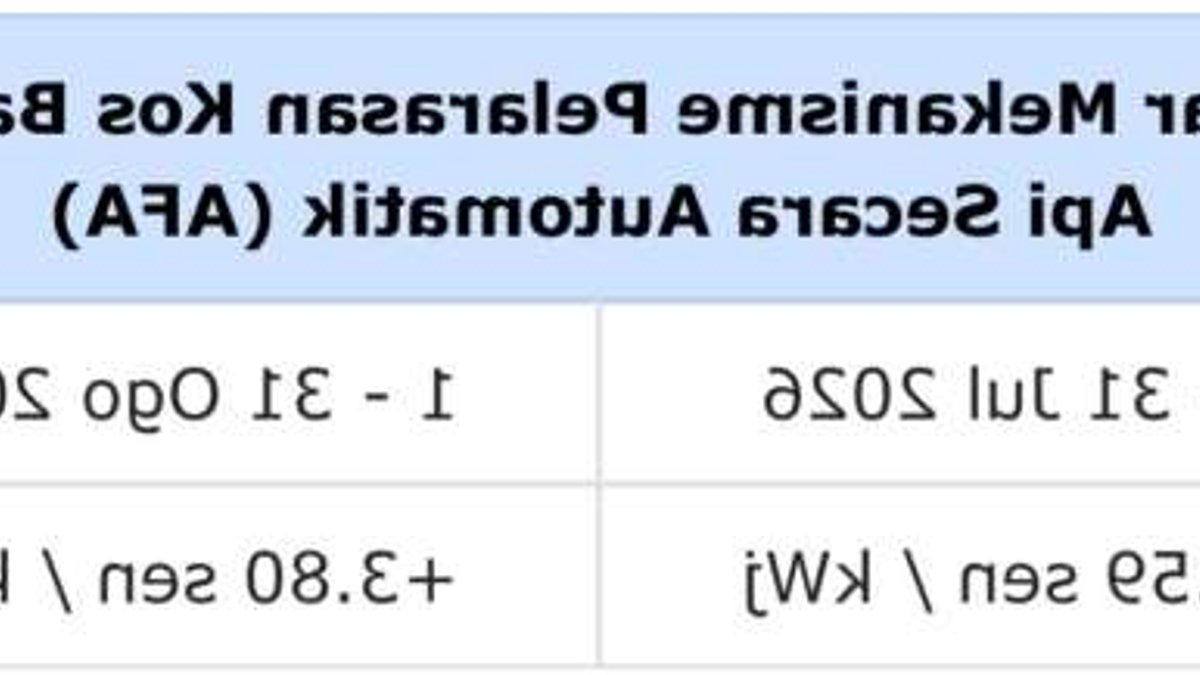
The Energy Commission’s Automatic Fuel Adjustment (AFA) rate for August 2026 was set at +3.80 sen per kilowatt‑hour, a modest rise from the +3.59 sen/kWh applied in July.
How the August figure compares with recent adjustments
Even before the Kumpulan Wang Industri Elektrik (KWIE) fund’s contribution, the pre‑subsidy AFA stood at 4.28 sen/kWh, translating to a cost of RM452 million for the month. That amount is lower than July’s RM583 million, which was based on a pre‑subsidy rate of 5.55 sen/kWh.
KWIE’s role this month was markedly smaller. It absorbed only 11 percent of the increase—about RM51 million, or 0.48 sen/kWh—whereas in July the fund covered 35 percent (RM206 million, or 1.96 sen/kWh). The subsidy has fluctuated widely over the past four months, from RM91 million in May to RM87 million in June, then spiking to RM206 million in July before dropping to the current level.
Related: MIROS Trials Minimum Highway Speed, Slow Driving Risks
Underlying fuel price movements
Single Buyer’s data shows that fuel prices in August remained above the baseline used for tariff setting, but the excess was smaller than in July. Tier 2 gas fell sharply to RM60.42 per mmBTU from RM75.58 in July, while Tier 1 gas rose to RM31.71 per mmBTU, still below its RM35 baseline. Coal prices increased to USD131.71 per metric ton, which, after converting at the August exchange rate of 4.0557 RM/USD, equals RM24.48 per mmBTU.
The steep decline in Tier 2 gas, combined with a milder true‑up for May’s generation costs, pulled the pre‑subsidy adjustment down despite higher coal prices. Generators reported efficient operation in May, needing alternate fuel for only one day, and actual generation costs were just 1 percent above forecast.
That true‑up process, which reconciles earlier generation costs with forecasts, contributed only a small upward tweak to the August AFA. By contrast, the April true‑up had added a 16 percent cost overrun to July’s rate, reflecting record peak demand at the time.
Related: BMW Motorrad Q2 Profit Rises 15.2% Despite Lower Deliveries
When the July rate was announced, Tenaga National Berhad (TNB) had projected an AFA of +8.33 sen/kWh for August—more than double the final figure. Even the pre‑mitigation estimate of +4.28 sen/kWh fell well short of that projection. TNB notes that its three‑month outlook serves as a planning tool, and the final numbers often differ after reconciling actual fuel costs, true‑ups, and KWIE subsidies.
Looking ahead, TNB’s latest three‑month forecast, updated at the end of July, shows a gradual easing: +5.00 sen/kWh for September, +6.81 sen/kWh for October, and +7.50 sen/kWh for November. The upward trend persists, but it is noticeably softer than the +8 sen/kWh‑plus figures floated a month earlier. Consumers should keep in mind that the effective AFA paid may again be lower than these projections if KWIE continues to provide support.
Consumers can reduce their exposure to the AFA by keeping monthly consumption below 600 kWh, at which point the surcharge is waived.
Related: Prasarana aims for 1.7 million daily riders
What the August AFA means for bill payers
For a typical household drawing 1,200 kWh in August, the AFA adds that rate to the bill, resulting in an extra RM45.60 before any subsidies. After KWIE’s 11 percent contribution, the net increase drops to roughly RM33.12. While the figure is higher than the July figure, the overall impact is softened by the lower KWIE share.
Overall, the August AFA reflects a combination of easing fuel price pressure, a modest true‑up, and reduced KWIE support. The trend suggests that future adjustments will likely remain within the automatic band, but continued monitoring of fuel markets and KWIE policy will be essential for consumers planning their electricity budgets.

MIROS Trials Minimum Highway Speed, Slow Driving Risks


